The Best Speech Therapy Toys: A Speech Therapist’s Favorite Picks for Building Language Through Play
The Best Speech Therapy Toys: A Speech Therapist’s Favorite Picks for Building Language Through Play
If you’re a parent wondering “What toys actually help my child’s speech and language?” — you’re in the right place.
Hi! I’m Ashley, a licensed Speech-Language Pathologist and the owner of For Goodness Speech, where I help children from birth through age 18 find their voice through play-based speech therapy.
Parents often ask me what the best speech therapy toys are for home use or for holiday/birthday gifts — and I always tell them that the most effective toys are the simple, open-ended ones that invite creativity and communication.
In this guide, I’ll share my favorite toys for speech therapy, how I use them in sessions, and how you can use them at home to support your child’s language development.
👉 If you’re new to speech therapy, you might also like these blog posts:
- Unlocking Language Milestones: How Many Words Should Your Child Have At Each Age
- Does My Child Need A Speech Therapy Evaluation?
What Makes a Great Speech Therapy Toy?
When choosing toys that support language development, keep these three simple principles in mind:
1. The toy doesn’t have to be fancy.
You don’t need expensive or “educational” gadgets for language growth. In fact, some of the best speech therapy toys are items you already have at home — like bubbles, cups, or blocks! We’ve all heard the statement “They love the box the toy came in more than the toy” and that’s often the truth!
Language happens during connection, not from a flashy screen or sound effect. Communication happens in every interaction of our daily lives, therefore the most important part of encouraging your child’s speech development is YOU!
2. Choose toys without batteries.
Toys that light up or talk often take away the chance for your child to make sounds, narrate, and use their imagination.
If you already have these toys, just remove the batteries — you’ll see how much more your child engages when they get to do the talking.
3. Pick open-ended toys.
Open-ended toys grow with your child. They can be used in endless ways, spark creativity, and help practice skills like problem-solving, turn-taking, and pretend play.
Disclosure: As an Amazon Associate I earn from qualifying purchases linked below.
My Favorite Speech Therapy Toys (and How to Use Them at Home)
🥔 1. Potato Head
Great for teaching body parts, vocabulary, and following directions.
💡 Try saying: “Where’s the eye?” or “Put the hat on!”
Target words: eye, nose, mouth, hat, shoes.
💡If your child is not yet talking, just keep it simple and model the different body parts as you put them in.
🎨 2. Play-Doh
A parent favorite! You can work on verbs and imitation while having fun.
💡 Model action words like roll, squish, cut, pull, push.
Encourage your child to copy what you do — imitation is a key first step in developing verbal speech!
🏖️ 3. Kinetic Sand
Similar to Play-Doh, but with a different texture that many kids love.
💡 Use it to practice descriptive words like soft, sticky, smooth or pretend play (“Let’s make cupcakes!”).
This is great for sensory exploration and language-rich conversations.
Alternative: if your child is sensitive to textures, put it in a ziplock bag instead or dry pasta!
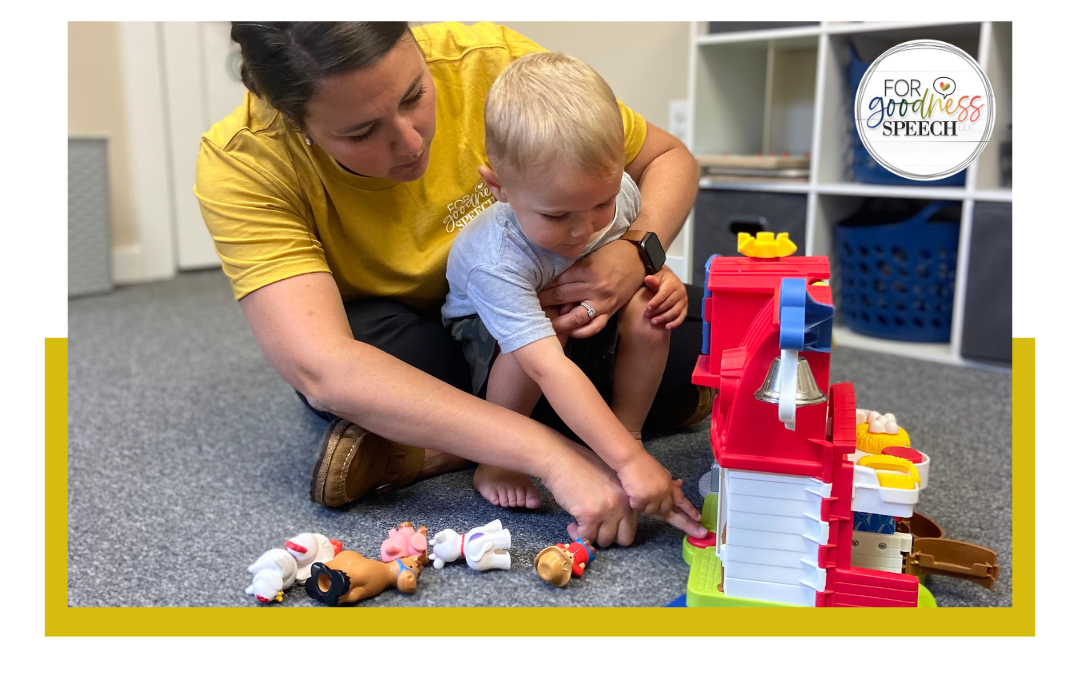
🐮 4. Toy Barn and Animals
Animal play is perfect for early speech sounds and imitation.
💡 Model animal noises like moo, baa, neigh, and encourage your child to copy.
You can also work on prepositions (“Put the cow on the barn”) and early words like eat, jump, up, down.
💡Animal noises are also great when working on specific sounds (initial /m/) or simple syllable shapes such as consonant-vowel (CV) as in “moo”.
Pretend cooking builds vocabulary, categories, and social skills.
💡 Practice phrases like want more, all done, open, eat.
You can also sort foods by color, type, or texture — great for early thinkers!
💡If your child is using two or three word phrases, model various questions while taking their order.
🧱 6. Stacking Blocks
Blocks are classic for a reason — they target spatial words and colors.
💡 Use simple direction phrases like Put it on top, Knock it down, or Build it up!
You’re not just building towers — you’re building language!
🧩 7. Puzzles
Puzzles teach requesting, turn-taking, and sound imitation.
💡 Hold the pieces and encourage your child to request them with signs, pointing or words.
Label each piece with words or sounds (beep (for car), neigh (for horse)).
Remember: imitation is paramount for language development and this is a great time to model simple sounds and encourage your child to imitate them!
🚗 8. Car Ramp
Perfect for teaching cause and effect, verbs, and sound play.
💡 Say Ready, set, go! as you send cars down the ramp.
Encourage your child to join in with words like crash, fast, slow. You can also pause before saying “go” and see if they can fill in the “go”!
💡Work on two word phrases such as “car go” or “car down” when playing.
🫧 9. Bubbles
One of my absolute go-to speech therapy toys.
💡 Blow bubbles, then wait! Give your child a chance to ask for more, open, or pop!
Encourage actions too: clap the bubbles, kick the bubbles, stomp the bubbles!
💦 10. Water or Sand Table
So much language can happen with sensory play!
💡 Use words like pour, scoop, stir, float, or sink.
Add toy animals or cups to encourage pretend and imaginative play skills together.
💧 11. Spray Bottle
Simple, affordable, and surprisingly fun!
💡 Practice following directions (“Spray the flower”) or verbs like spray, wipe, clean.
You can even target body parts (“Spray my hand!”).
🧲 12. Magnet Tiles
Great for creativity and problem-solving.
💡 Encourage your child to describe what they’re building (big tower, blue square) or ask for pieces (“I need a triangle!”).
Perfect for expanding sentences and using colors and shapes.
Why These Toys Work for Speech Therapy
Each of these toys encourages your child to:
- Engage and communicate during play
- Imitate sounds and actions
- Request and label objects
- Follow directions
- Use imagination to tell stories
And the best part? They’re budget-friendly, easy to find, and don’t require batteries. You can find most of these at stores like Target, Amazon, thrift stores or even the dollar store (spoiler alert, a lot of my toys are thrifted/from the dollar store!).
Remember, you may have a lot of these toys already, it’s just how you use them that makes all the difference!
Final Thoughts
The best speech therapy toys aren’t the ones that talk or flash — they’re the ones that inspire your child to talk and connect with you.
By playing intentionally with these toys, you’re helping your child build essential language skills while keeping it fun and stress-free.
Download The Best Speech Therapy Toys Guide
💬 Want to see if your child is on track?
Check out this helpful guide on language milestones next:
If you’d like personalized support for your child, I’d love to help.
Check out my services here: Speech Therapy CT Services
OR
Contact me here: Speech Therapy CT Contact Me